At the POP Movement, we define Initiatives as those that are country-based, as they are more geographically representative. All POP Initiatives are supported by the POP Movement in the form of seed grants and mentorship. On the other hand, Projects are those conceived and led by youth leaders independently. These projects have been showcased at the POP Movement, and some of them receive mentorship and support.
It is important to note that there may be multiple POP Projects, but there is just one POP Initiative per country
Vermiculture for education and sustainable feeding
This project is focused on cultivating earthworms through leveraging the use of organic fertilizers as part of organic vegetable productionand promoting good agricultural practices for…
Read MoreVermiculture for education and sustainable feeding
This project is focused on cultivating earthworms through leveraging the use of organic fertilizers as part of organic vegetable productionand promoting good agricultural practices for food sustainability.
Museum: Ambassadors of nature in action (EdeNA)
This initiative seeks to address the issue of marine pollution caused by single-use plastic.A museum will be curated through a collection of marine specimens from…
Read MoreMuseum: Ambassadors of nature in action (EdeNA)
This initiative seeks to address the issue of marine pollution caused by single-use plastic.A museum will be curated through a collection of marine specimens from fishing cooperatives and organisms and marine animals that are endangered or have perished due to natural and manmade causes.
Environmental education from the school garden.
The project contemplates the implementation of a school garden to use it as an environmental education tool, seeking the positive impact on students and their…
Read MoreEnvironmental education from the school garden.
The project contemplates the implementation of a school garden to use it as an environmental education tool, seeking the positive impact on students and their families.
Lessons from the coronavirus: workshop course on urban gardens.
Lessons from the coronavirus pandemic have inspired this project which focuses onthe economic problems that arise from the COVID-19 crisis.The shortage of economic resources affects…
Read MoreLessons from the coronavirus: workshop course on urban gardens.
Lessons from the coronavirus pandemic have inspired this project which focuses onthe economic problems that arise from the COVID-19 crisis.The shortage of economic resources affects people’s nutrition, especially in developing countries like Mexico. Focussing on self-sustainability, the initiative works to encourage the production of food in asustainable way in one’s own home.
eCycle – Tackling electronic pollution in New Delhi, India
Background: Air pollution in India kills more than two million people a year, and according to the World Health Organization, the pollution in New Delhi…
Read MoreeCycle – Tackling electronic pollution in New Delhi, India
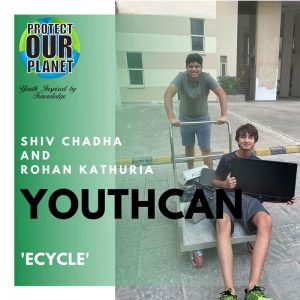
Background: Air pollution in India kills more than two million people a year, and according to the World Health Organization, the pollution in New Delhi is the worst out of any major city in the world. The Supreme Court of India also said, “Delhi has become worse than narak (hell).” A lot of this pollution comes from vehicular waste, waste from industries and crop burning. However, another cause for air pollution that most people fail to recognize is electronic waste. Electronic waste releases toxic chemicals such as lead and mercury which when inhaled by people or animals can lead to fatal diseases affecting the liver and brain. Furthermore, hazardous materials in electronic waste also contaminates the soil creating an unhealthy environment for plants to grow. One of the fundamental problems associated with e-waste is that most people do not know that electronic waste is supposed to be segregated and not thrown away along with the regular waste.
eCycle is an initiative founded by two high-school students from New Delhi, India, in 2019 to help deal with the electronic waste generated in the surrounding local communities. The eCycle team collects e-waste from households across communities in New Delhi including laptops, phones, chargers, and so on. Having partnered with Samsung and Croma, eCycle works with them to ensure that the unusable e-waste is deposited at the government-authorized recycling centers and the discarded electronics that are in usable condition are distributed to disadvantaged people in the rural areas.
So far, eCycle has collected over 500 kilograms of electronic waste and has helped create a better environment for over 10,000 people. Their goal is not only to collect and safely deposit e-waste, but also to raise awareness about the issue and sensitize people about the need to segregate the hazardous e-waste from others. The team aims to take this initiative forward through POP Movement’s Youth CAN by networking with like-minded young activists and being part of a space for sharing resources, opportunities, and inspiration.
The environmental index project – Colegio Marymount Cuernavaca
Seeking to reduce students’ general consumption by fostering social and interpersonal competition, this project involves a survey of habits using parameters like consumption of meat…
Read MoreThe environmental index project – Colegio Marymount Cuernavaca
Seeking to reduce students’ general consumption by fostering social and interpersonal competition, this project involves a survey of habits using parameters like consumption of meat and packaged food, water and electricity use, clothes shopping etc. The feedback from this survey contains a numerical “environmental index”, and also presents the challenges that a student needs to overcome using the available scope of opportunities. Periodical implementation of this survey among a group of students with an aim to improve the environmental index, has enabled them to take tangible steps to be more eco-friendly.
Eco-toxic impact of polypropylene resins at their end-of-life cycle – Universidad Nacional Autónoma de México
This project aims at adopting a culture of "circular economy" to work against the problem of massive waste generation in human society. In México, municipal…
Read MoreEco-toxic impact of polypropylene resins at their end-of-life cycle – Universidad Nacional Autónoma de México
This project aims at adopting a culture of “circular economy” to work against the problem of massive waste generation in human society. In México, municipal solid waste ends up in landfills and water bodies. Depending on the method of final disposal of plastics, toxic substances like furans,dioxins and other metals like cuprum, vanadium and nickel are released. Principal damage caused by plastics is through its end-of-life cycle, when it isn’t disposed in the right manner.
Restoration and reforestation of fragmented forests with native tree species and the creation of local conservation areas in the municipality of Zinacantán, Chiapas
This project works towards the establishment of an integrated agro-ecological center with agroforestry and permaculture system for the rescue of native trees in the municipality…
Read MoreRestoration and reforestation of fragmented forests with native tree species and the creation of local conservation areas in the municipality of Zinacantán, Chiapas
This project works towards the establishment of an integrated agro-ecological center with agroforestry and permaculture system for the rescue of native trees in the municipality of Chanal, hiapas.
It aims to establish a center where people will be trained through workshops, work tables, documentation and other dynamics in order to clearly interpret what is happening to Mother Earth and to raise awareness among the inhabitants of the municipality. The next step on the agenda of this project is to collect native timber seeds that are facing extinction, and use the opportunity to train the local community in the process of growing seedlings of forest nurseries. The project is implemented through the local civil society organization called “Change Agents” which creates a space, which enables the implementers in the Chiapas to perform environmental management in their community by employing conservation methodologies.
Ecocolillas – Universidad del Caribe
This initiative seeks to design containers for collecting cigarette filters at key locations in the university campus, clean and reuse those filters through chemical treatment…
Read MoreEcocolillas – Universidad del Caribe
This initiative seeks to design containers for collecting cigarette filters at key locations in the university campus, clean and reuse those filters through chemical treatment and conduct awareness campaigns on the need to preserve the delicate ecosystem. It has been implemented on the university to reduce the environmental impact of cigarette waste.
